🐍 Level up your Python game — code like the pros do!
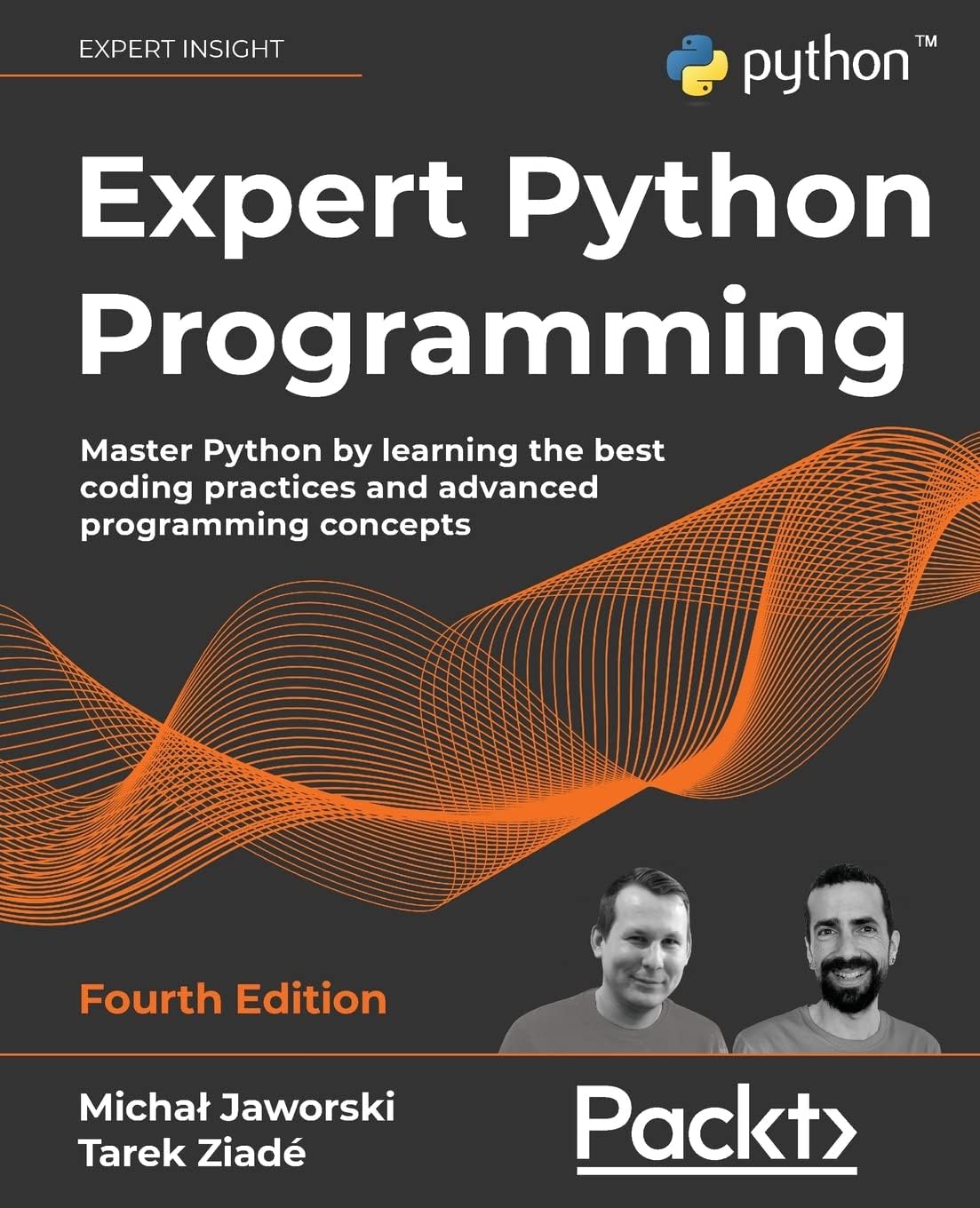
Expert Python Programming, 4th Edition, is a definitive guide for experienced developers aiming to master advanced Python concepts including C extensions, metaprogramming, concurrency, and testing automation. Highly rated and packed with practical examples, it’s the essential resource to elevate your coding skills and stay ahead in the fast-evolving Python ecosystem.


| Best Sellers Rank | #1,131,659 in Books ( See Top 100 in Books ) #302 in Object-Oriented Design #720 in Introductory & Beginning Programming #870 in Python Programming |
| Customer Reviews | 4.6 out of 5 stars 94 Reviews |
S**H
Great in-depth implementation details with many coding examples
Great in-depth implementation details with many coding examples and importantly interesting read with continuity established to proceed each of next chapter..
K**R
Learn the Most Advanced Python Techniques
About This Book So you think you know Python? I bet you don’t, at least not to this level. But this book can change that. While you might know how to do most anything in the language, can you write C extensions for a performance boost? How are your metaprogramming skills? Can you handle concurrent programming? This book discusses all of these and a lot more. Who Is This For? The primary audience for this is a very experienced programmer that uses advanced Python in a production environment. Those of us who use Python for simpler problems will also get some useful tips and tricks from this book as well. Organization At first, I was perplexed that there was no macrostructure to this book, but after looking at the table of contents, I realized that would have been difficult. Each of the topics after the first few introductory chapters is completely different with little to no relationship. Within each chapter, however, the author placed Technical Requirements and Summary sections. This helps the reader understand what they need to know before reading the chapter as well as give a refresher afterward. Did This Book Succeed? I think this is a great book to learn those last bits of Python that most people miss. Want to keep up with the latest on the language? There’s a chapter about that. Want to improve your testing automation? This book discusses it. It’s THE book to top off your Python programming abilities. Rating and Final Thoughts Overall, I give this book a 5 out of 5. If you’re a Python developer, get this book to learn a few new skills that your fellow devs won’t know. You’ll learn new techniques and refine old ones that will let you program in new ways. It belongs on your bookshelf.
H**T
Great Content on a Great Set of Topics
I have about two years of experience using Python, and I find this book very helpful in moving forward. The first chapter gets everyone off to a great start by sharing ideas about how to stay up-to-date with Python, as the language inevitably changes, and where to find Python community. All of the chapters are important and contain great information. I particularly like Chapter 4 which compares Python to other languages, and emphasizes that just because you might be able to write code as you would in another language, that is not necessarily the "Python way", nor the best way to do it in Python. The chapter identifies places where programmers might try things they really shouldn't. I have combined C/C++ code with Python, and so, I enjoyed reviewing the chapter which covers this topic. I closely read and enjoyed the chapter on Optimizing Code, one way of course is via choosing the best data structure. This helps the programmer learn not just what data structures are available but provides info on how data structures can impact performance. I have not had to profile code, but I think Chapter 12 would be very useful on that. I am very interested in going further and carefully reading the chapters on Interfaces, Patterns, and Modularity, on Testing and QA, as well as Concurrency, and Meta-programming. There is a lot of great material here.
P**1
This covers pretty much everything that you would need to know for an entry-level position.
Good book very thorough and knowledgeable on the subject.
G**L
Great Addition to Any Python Developer's Library
BLUF: Regardless of your experience with Python, you'll benefit from this book. PROS: - Well laid out format. Authors put thought not just into content but into presentation as well. - Chapter that gives specific examples of Python juxtaposed with other well-known (and some rather obscure) languages. As a JavaScript practitioner, I found that especially helpful. - Just enough detail. The authors don't shy away from "going down the rabbithole" on a particular module or two. I appreciated the section on the graphlib module (as a data analyst). - Advanced tips for both hobbiests and professionals alike. The authors' tips on development environments were excellent. CONS: - Not enough detail (in some cases). For example, the author's treatise on the poetry environment manager did not even touch other well-known "third party" managers (namely Anaconda). As a "Conda" user, a comparison between poetry and conda would have been helpful. - Too much detail (in other cases). I know this may seem contradictory given my previous statement but at times, the authors go the extra mile... and it seems a bit overkill (which may be my attention span, but there you have it). - A bit utilitarian at times. This book lacks the cutesy graphics that No Starch Press incorporates in all their books. This again is personal preference but something like that would make this book a much easier read. In conclusion, this isn't the only good "expert" Python book out there, but it's excellent and well worth having.
E**T
Greast book for beginners and Advanced users
The early part of the book is excellent for those just getting started and later parts of the book appear to be excellent resources for very advanced users. The Python history can be useful yet it was not tediously long. The early part of the book is a step by step getting started from scratch. Following the rules and procedures laid out here will save you a great deal of time later. The term “Isolation” is one of the key words in this area. Good quick review of history and justifications for moving to version 3. Very good list of resources for python sharing communities. Introduction to the Python Package Index PyPi guides you to an enormous wealth of tools. The comparison with other languages does not try to over-sell Python. It freely admits that other languages have some very strong points but does show many of the key advantagbes of Python over a wide range of projects. One of my favorite advanced areas is the Multi-threading topics. In this age of servers with 4, 8, 16 and more processors, this can be so powerful and the book lays out how to accomplish this and thus assist you to implement some key programs to have parallel processing. Chapters 8 and beyond opened up new areas that were brand new to me and most programmers I work with. I have not attacked those ideas as of yet.
A**R
How to take your Python game to the next level
As the title might imply, "Expert Python Programming" is a book that will take your Python skills to the next level. The book covers a wide range of topics in Python - it contains a solid amount of historical information regarding the current state of Python 3.9 and recent additions to the language, as well as plenty of technical information regarding functionality within the language and how best to utilize those features. The layout and examples within the book make it useful both for those who are novices in Python as well as more experienced programmers. It does a good job of catching everyone up to the same page, including a description of development environments for Python, before diving into the features in more detail. My favorite section was the chapter showing how you can use Python and C/C++ together. Those are the primary languages that I use (for both work and hobby), so it was really cool to see how the book showed tools to connect the languages together. Overall, I think this book is a solid choice if you want to really excel in your Python programming. Even if it says that it is an "Expert" book, it is still appropriate if you're just getting started with Python and feel comfortable with the basic syntax and semantics. It will do a fantastic job of accelerating your knowledge and experience of Python, and I know that I'll have this on hand as a reference if and when I need to develop my Python skillset further!
S**R
Best book on Python so far
I have written Python code for about 15 years now. Even though many times that hasn't been what I wrote for my day job, it is still my favorite programming language. I didn't think there was much to learn, but then again I started as a Python 2 developer and only switched to Python 3 in the last few years. But this book is great and taught me a bunch of new things. I learned about Poetry, which I never heard of until now, and can't wait to use it on my next project. It also walks you through using Docker for development and explains why you may want to still use Vagrant in some cases even though it is an older technology. It even goes into writing C extensions to give your Python projects a performance boost. You should know some Python before reading this book, as it goes into some concepts in-depth, but I would recommend it to anyone who has been writing Python code for a few months.
Trustpilot
2 months ago
2 months ago